A custom-built flight-case filled with inspiring, hackable, educational technology, travelling from school to school a term at a time.
- When
- Nov 2014 – 2017
- Stage
- A prototype
- Outcome
- A successful short-term project: several hundred primary-school children got to experiment with robotics. Gavin, Stef's collaborator on the project, went on to take a headship at a new school and kept robotics going there in the classroom.
Announced November 2014, in collaboration with a local primary school, funded by a £50,000 ($80,000) grant from the Clore Duffield Foundation's 50th anniversary Clore Prize.
Stef put the question this way: "What would you give a child to inspire an interest in technology? A box full of awesome things perhaps?" The starting point was his own childhood — the Domesday Project on a laser disc connected to a BBC Micro B, a plasma globe, and a programmable LOGO turtle that drew patterns on paper with a pen mounted inside it.
The observation behind the project was that screen-based educational apps were well served, while physical computing was not: "there's recently been an explosion in another area that I think hasn't been explored as much yet – physical computing, electronics kits, Arduinos, educational robots, Raspberry Pi-based computers, sensors, gyro-copters, and lots of other exciting things."
The plan: "prototype an 'awesome box' — a custom-built flight-case filled with inspiring, hackable, educational technology – electronics kits, video microscopes, gyrocopters, robots, sensors, and lots more. We'll have lesson plans included, so the box could arrive one day in a school, and by the next, children could be using them in lessons. The box would be something that you'd have in your school for a term and then pass it on to another school."
Three stated principles for what went in it: "Is it awesome — could you imagine a child saying 'wow that's awesome' when they see it for the first time? Is it hackable — can you plug it into something else and change the way it behaves? Is it educational — can you see ways to use it for teaching?"
The box was co-designed with children, and the name was provisional: "I'm hoping they will have a hand in choosing a name for it once we've prototyped it."
The name of the wider effort comes from William Gibson — "The future is already here — it's just not very evenly distributed" — giving the project its aim: "let's distribute the future."
It was set up as a community non-profit company called Distribute The Future, at distributethefuture.com. The company existed only to carry the box.
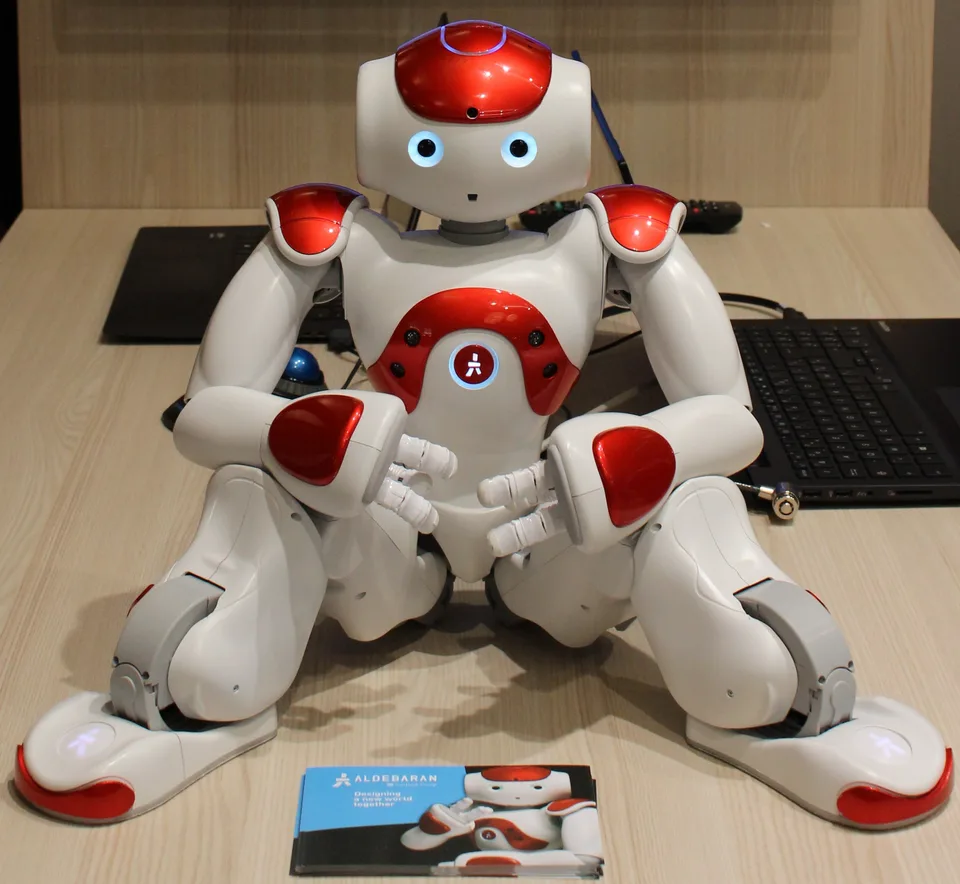
Distribute The Future ran to three strands, in his own later summary: “prototyping a box of equipment that multiple schools could use without technical training, an after-school robotic storytelling programme using two Nao robots aimed at children in benefit of the Pupil Premium, and working with staff at two London schools around introducing electronics and algorithms in lessons.” It ran from 2015 to 2017.
The question the box was built around — how do you get children making technology rather than only consuming it — is one Stef had already been speaking about: “Teach Your Kids to Create as Well as Consume Games”, a Pecha Kucha lightning talk given in May 2014, six months before the box was announced.
The longest outcome is a family one. Stef's eldest daughter grew up around those robots, and is now studying creative robotics at university.
now offlinearchived copy
Around the same time
- Black To Comm — Black To CommMusic · 2014
- Let’s distribute the futureWriting · 2014
- Jon Mueller & Duane Pitre — Inverted TorchMusic · 2014
- Monsters! Everywhere!Writing · 2014
Earlier in projects: Internet Of Things, Where Are You?. Later in projects: The Memrise Prize.